
 ParentSquare
Elm Road PennPALS
The pictures below are of the PennPALS classroom at the Elm Road Elementary site.
Coping with Anticipatory Grief
During this uncertain time and time of change, it is important to take a moment to share information about anticipatory grief, what it is, possible signs and sources of support and help. Grief is typically associated with loss through a death, but the grief process can follow any type of loss, including losses that may result from COVID-19. The term anticipatory grief is not a new concept as it can relate to what occurs when people are expecting or anticipating the loss of something or someone. For instance, a person may experience anticipatory grief if they are going through a divorce or have received a life-changing medical diagnosis. Some people may experience anticipatory grief as they approach retirement because there is a change occurring and the retirement marks the ending to a chapter in one's life, even though it can be an exciting time as well. Anticipatory grief is relevant to all of us at different points in our lives, and is particularly of interest as we are adapting to changes due to COVID-19 as the concepts related to anticipatory grief can also be applied to what we are experiencing with COVID-19. Therefore, the information contained here really is an overview of anticipatory grief, signs, and how to cope in healthy ways. The information will hopefully be helpful as we deal with COVID-19 changes, and may be of benefit for other life events.
Some of the things that we are grieving as a result of the COVID-19 pandemic include:
- Worry about loved ones
-
Social distancing, quarantining, and possible feelings of isolation
-
Changes in daily habits and routines
-
Special plans and events that have been canceled
-
Perhaps we are retiring and we are feeling a sense of loss because this is not what we expected for our last year in education
-
Our students might grieve leaving their classes early, not being able to have some spring and summer sports and activities
-
Worries about how to pay rent, utilities, and other bills
-
Sadness over how the pandemic will affect the world
-
Fears for the futureJob loss
-
Loss of feelings of safety when in public
These types of triggers can be related to what is called anticipatory grief. It is important that we are all aware that may be experiencing anticipatory grief. Furthermore, knowing of anticipatory grief may help us help others as feelings of anticipatory grief may also be impacting our loved ones, our students, our friends, and our colleagues.
Possible Signs of Anticipatory Grief
Since anticipatory grief may be impacting many of us at this time, it is important to remember that grief is a normal reaction to a loss. We all experience grief at some point in our lives. Following are some signs that you might be coping with anticipatory grief in light of the pandemic:
- Difficulty focusing on normal tasks
- Fatigue or low energy
-
Sleeping much more or less than usual
-
Feelings of anger and irritability
-
Headaches and upset stomach
-
Re-experiencing feelings of past grief (anticipatory grief brings on other feelings of grief, which can cause your brain to think about previous losses
-
Engaging in activities such as eating, drinking, or online shopping to cope with stress and anxiety, especially more so than usual
-
Avoiding thinking or talking about the pandemic
If you notice any of these signs in yourself or loved ones, it is important that you recognize them for what they are and take steps to cope and support yourself or your loved ones.
Positive Ways to Cope
If you recognize any signs of anticipatory grief, it is important that you take steps to help one cope in positive ways. You can engage in the self-care and stress management techniques, such as good sleep hygiene, regular exercise or movement, eating a healthy diet, deep breathing, progressive muscle relaxation, mental imagery, autogenic relaxation, celebrating the positives, expressing gratitude, art, listening to or playing music, making time for relationships so we feel connected, and working to create a sense of belonging, which is particularly important right now as we may feel somewhat isolated. Prayer, meditation, and mindfulness are extremely helpful for many when going through the grief process. Please check out the SEL resources and/or PD videos for more information on mental wellness at this link. At times, we may need to reach out to a trusted friend or even a mental health professional when needed. It is important to reach out so that you are healthy, and can even be in a better position to help others when needed.
Supports Are Available
The Coronavirus Pandemic can cause uncertainty so I want to make you aware of supports to help bring about a sense of calm during these storms. Infectious Disease outbreaks like the Coronavirus cause many feelings of distress and anxiety, as well as cause feelings of confusion, being overwhelmed, powerless and scared. These are normal feelings in all of us, even if we are not at high risk. There are many actions we can take to support one another during this time.
The Division of Mental Health & Addiction (DMHA) also recommends that Hoosiers feeling distress or anxiety due to the pandemic call the Substance Abuse and Mental Health Services Administration’s (SAMHSA) Disaster Distress Helpline at 800-985-5990.
- Live crisis counseling
-
Toll-free
-
Multi-lingual
-
Confidential
-
Text option is also available: Text “TalkWithUs” to 66746 to connect with a trained crisis counselor
Suicide Prevention Lifeline – The Lifeline provides 24/7, free and confidential support for people in distress, prevention and crisis resources for you or your loved ones, and best practices for professionals Call
1-800-273-TALK.
Safe School Helpline is a 24/7 communication service that empowers school administrators to make proactive decisions as well as creating reporting responsibilities for students, parents and community members to share in the maintenance of a safe learning environment. This is monitored around the clock so reports can be addressed in a timely manner. Call 1-800-4-1-VOICE x359 to make a report.
P-H-M School Counselors & YSB – If you have students in your life who need supports, please know P-H-M School Counselors at the middle and high school, as well as Youth Service Bureau Specialists, are available during normal school hours if you need additional information or resources. Please reach out to the counselor specifically, or contact the principal at your child or teen's school for non-emergencies. If you do have mental health crisis related to suicide ideation, please call 911 for immediate risks.
Please do not hesitate to reach out for support. They are available to help us through this uncertain time.
More Information is Available on P-H-M’s SEL & Mental Health webpage
For more information on grief with children as well as managing stress related to COVID-19 and talking with your child about COVID-19, please check visit the SEL webpage on P-H-M’s website, or click on the links. Please click here for a link to COVID-19 resources related to managing stress and talking with your child or teen about it.
2020 Spring Break Ideas
Zoo / Animal Activities:
- San Diego Zoo Live Cams
- Houston Zoo Live Cams
- Cincinnati Zoo Facebook Live Events Schedule
- Watch puppies being cute
Aquariums:
- Follow The Shedd Aquarium on Facebook
- National Aquarium Virtual Tour
- Georgia Aquarium Beluga Whales Live Cam
Art Museums:
- Snite Museum “Our Collection, Your Inbox” Email List
- The Louvre Free Virtual Tours
- Smithsonian Museum of Natural History
National Park Virtual Tours
Send an eCard to Friends and Family:
Family Fun:
- Family Karaoke Night, search youtube for free Kaoke versions of your favorite songs or use a premium site like KaraFun or SingSnap
- Perform a play, view free scripts at Playscripts.com or write your own play!
- Break out family favorite board games and regular old playing cards
- Movie Night, Turn down the lights, make popcorn and stream your favorite movies.
- “Drive-in” Movie night. Turn cardboard boxes into cars and pick a theme for the night (action/adventure, tropical, sports, etc)
Fun with Food:
- Cook Together, try one of these kid-friendly recipes
- Have a stay-at-home picnic, try these food ideas or make your own.
- Make your own pizza, experiment with new toppings!
- “The Great British Bakeoff” at home: choose a basic idea, like cookies, cakes, brownies, etc. for the “bakers” to make but give then a challenge of decorating, or a theme, or a unique flavor that they must use.
-
“Chopped” at home: put mystery ingredients in a basket for contestant family members to cook and use other family members as the judges. Don’t forget to set the stop clock!
Puzzles:
- Jigsaw Explorer Free online puzzles
- Jigzone Free online puzzles
- Jigsaw Planet Free online puzzles
- Or, dig through closets and bring out your own physical puzzles that you haven’t used in awhile!
Get Crafty:
- Cardboard construction. Turn all those Amazon boxes into buildings, cars, airplanes and more!
- Create a board game, use this to get started.
- Recreate famous works of art like this!
-
Make your own Playdough with this recipe
Fun with Literature:
- Like Harry Potter? Bring Hogwarts Home!
- Join the Mishawaka-Penn-Harris Public Library Learning Family Challenge
- St. Joseph County Public Library Facebook page has virtual storytimes and other reading activities
Scavenger Hunts
- Host your own. This app is free for recreational use.
- Math Scavenger Hunt
- Reading Scavenger Hunt
Go Outside (Please avoid crowded parks and jungle gym equipment)
- Use sidewalk chalk to do something creative
- Fly a kite!
- Exercise! Get that heart rate up with these backyard exercises
Storytelling
- Start a family podcast. Practice interviewing family members and learning about them. Record on your phone and share the episode with friends and family everywhere. Free plans available here.
- Write your own book. Whether you write 5 pages or 100 pages, here’s some things to consider
-
Record kids reading story books that can be shared with others, like grandparents or possibly nursing homes
Facts about Lead Poisoning
Lead poisoning is caused by swallowing or breathing lead. Children under the age of six-years-old are more at risk. Lead poisoning can also harm unborn babies, so pregnant women should also take precautions.
Lead can cause learning and behavior problems because lead harms the brain and nervous system. Some of the effects of lead poisoning may never go away.
Lead in a child’s body can:
- Slow down growth and development
- Damage hearing and speech
- Make it hard for children to pay attention and learn
Most children get lead poisoning from paint in homes built before 1978. When old paint cracks and peels, it makes dangerous dust. The dust is so small that it cannot be seen with the naked eye. Most children get lead poisoning when they breathe or swallow the dust on their hands and toys.
Lead testing is the only way to know if a child has been exposed to lead poisoning. Most children who have lead poisoning do not look or act sick.
Parents are encouraged to talk to their pediatrician if they think their child may be at risk for lead poisoning. Testing is available through your family doctor as well as the St. Joseph County Health Department.
Click here to visit the Health Department website for more information on lead poisoning, how you can protect your family, and safe cleaning tips if your home has lead paint.
Gaming Disorder
Games can be fun and used as effective learning tools. Most games in and of themselves are not bad. However, there is another side to gaming, especially when gaming is not used in moderation. According to the World Health Organization (WHO), excessive use of screens (internet, computers, smartphones, and other devices) has negative health consequences and the WHO now recognizes gaming disorder as an addiction to playing video games per the International Classification of Diseases, 11th Revision (ICD-11). The ICD is used to identify health trends and statistics around the world and is the international standard for reporting, diagnosing and researching diseases and health conditions. This information is also used when planning for public health. Gaming disorder was included in the most recent version of the ICD released in 2018 after reviewing evidence and consensus from experts in different regions and disciplines. The inclusion of gaming disorder allows for the development of treatments for those with the condition as well as health professionals being aware of the disorder to consider prevention and treatment methods. To date, gaming disorder is not listed in the Diagnostic and Statistical Manual (DSM) published by the American Psychiatric Association, which is used by mental health professionals, such as psychologists; more research is being considered before it is included as a formal disorder in the DSM.
According to the WHO’s ICD-11, gaming disorder is defined as a pattern of gaming behavior (“digital-gaming” or “video-gaming”) characterized by impaired control over gaming, increasing priority given to gaming over other activities to the extent that gaming takes precedence over other interests and daily activities, and continuation or escalation of gaming despite the occurrence of negative consequences (World Health Organization, 2018).
There is some controversy around the use of the gaming disorder diagnosis, especially because it can pertain to children and it falls along the lines of a type of addiction. As we know, addictions do not only involve drugs or alcohol. People may have addictions to gambling or food, for example. An addiction is a disease of the brain that involves the reward, motivation and memory centers. In essence, whenever your brain’s reward centers are triggered, then hormones (dopamine) that make us feel good are released and that feeling keeps one coming back for more. The behavior is further reinforced through intermittent reinforcement, much like a slot machine in gambling, because you never know when you will get a reward in the game.
Addiction involves an abuse or dependency on a substance or behavior (in this case technology use) that is “beyond your control and outside the realm of reasonable use.” Secondly, “and most importantly,” Dr. Greenfield, who is an Assistant Clinical Professor of Psychiatry at the University of Connecticut School of Medication, says it must be “impacting your life in some negative way, whether it be your home life, work, school, economics or social relationships.” One may find yourself playing video games all day rather than talking with friends and family, getting work done or caring for yourself or others. You may also lose track of time, be preoccupied with the game even when you are not playing, and/or use games to escape negative feelings (e.g., boredom, anxiety, anger, frustration, etc.) . If you have struggled to regain control of your life, that is also an area of be mindful of as you consider risk factors. The behaviors WHO lists as characteristics of gaming disorder are as follows:
- Impaired control over the onset, frequency, intensity, during, termination or context
- Increasing priority given to gaming to the extent that gaming takes precedence over other life interests and daily activities
- The continuation or escalation of gaming despite the occurrence of negative consequences. The behavior pattern is of sufficient severity to result in significant impairment in personal, family, social, educational, occupational or other important areas of functioning.
- The pattern of gaming behavior may be continuous or episodic and recurrent. The gaming behavior and other features are normally evident over a period of at least 12 months in order for a diagnosis to be assigned, although the required duration may be shortened if all diagnostic requirements are met and symptoms are severe.
If you are interested in taking a brief screener to gather more information and start thinking about this more, then click here to check out the Greenfield Video Game Addiction Test.
*NOTE- Just because you score high does NOT automatically diagnose you with this addiction. A diagnosis cannot be made on the basis of one screening measure alone. This needs to be done by a healthcare professional. This screener is meant to give you a little more insight into areas that may be red flags and if you score higher than 7 points (out of 17), you may want to consider talking with a healthcare professional.
While gaming disorder affects only a small proportion of people, all who play games should be aware of how much time they spend on gaming activities, especially when that is their exclusive activity or pastime.
It is important to remember that some games are fine; however, when the gaming spirals out of control, it signals a problem, even if it does not rise to the level of an addiction or disorder. There is a continuum from an occasional game to the other side of the spectrum where people have actually died of exhaustion, stress, malnutrition and dehydration from playing games for days on end (WHO does not refer to these extreme cases). If there is a lack of control, the feeling of needing to try to stop or lie about it, then there is a risk.
Intervention Strategies:
Since the idea of gaming as an addiction is a new idea, research is still being developed to consider evidence-based interventions. It is okay to quit games cold turkey. If you need help, do not hesitate to consider the help of a mental help professional that has expertise in compulsive behaviors. It is also important to fill the time with healthy options so the gaming is not replaced with risk-taking or dangerous behaviors. Instead, exercise or other activities that are healthy and also release dopamine are excellent replacement behaviors.Here are some additional ideas on how to overcome gaming:
1. Start by identifying the time on gaming. Admit that it is something with which you can make better choices. Become self-aware and work to gain an accurate self-perception of what is taking place.
2. Once you are aware, you can help your child work toward self-management. As a parent, work to get buy-in from the start. Get a general idea of how much time is spent (baseline). Help the student understand what they are missing when they are gaming. Let them know you want to help set a healthy balance and you do not want to take it away altogether. Have your student be a part of the conversation so they can identify reasonable limits. Allowing them to be a part of the conversation empowers them and will often increase buy-in. Going through this process now will help your student learn to make healthy choices when they are older.
3. Help identify healthy replacement behaviors. While you are talking with your child, brainstorm a menu or list of many activities with which they can engage in rather than game so you can replace the behavior with something that can serve the same purpose. This will vary for different people. As mentioned, something that will release dopamine, such as exercise is a healthy alternative.
4. Think about a plan to limit time spent gaming…Start small and incrementally decrease the time spent on gaming. Or, set a max time, such as 1 hour per night total. Or, for every minute you spend studying or working out/training, you can earn a minute for gaming. Or, you can cut it cold turkey.
There’s an app for that: Break Free App (monitors time spent on phone) or an app where parents can control when a student is or is not on their phone-review data and then make adjustments.
5. As hard as it is, as adults we must look at our own gaming time. Some adults spend a lot of time gaming and children learn from examples. Work with your child to keep things in check and make sure there is a healthy balance.
References and Resources:
- Relationships in the Digital Age. HarperCollins: New York.
- Book written by a clinical psychologist who looks at the way screens are changing family dynamics and offers useful solutions.
- The Center for Technology Addictions by Dr. David Greenfield, https://virtual-addiction.com/about-us/
- World Health Organization
- IDC-11 Gaming Disorder
- https://www.who.int/features/qa/gaming-disorder/en/
Childhood Aggression
WHAT IS AGGRESSION?
While we often think of aggression in overt terms, aggression can include emotional, mental, verbal and physical forms. Aggression includes hostile or violent behaviors or attitudes toward another person or group. Aggression can include behaviors such as arguing, yelling, berating, bullying, intimidation, excluding others, starting rumors, using force to get something or physically fighting. It can occur in the physical, verbal, or virtual realms (i.e., cell phone, social media).
While statistically males are more likely to engage in physical aggression, females are often more likely to engage in non-physical forms of aggression, such as relational aggression, social rejection and verbal aggression.
Aggressive acts can be impulsive or planned. Impulsive acts of aggression are typically in response to strong emotions (often anger) and takes place in the heat of the moment. This type of aggression triggers physiological response in our brains (amygdala, hypothalamus and periaqueductal gray). Instrumental aggression is also known as predatory aggression, and is planned with the goal of causing harm to achieve the aggressor’s goal.
POTENTIAL REASONS:
Aggression typically happens after a person perceives a threat. Aggression can be deliberate or a response to poor emotional control (e.g., irritability, easily angered). Although there is typically not one reason, rather a mix of various reasons, and can be sometimes difficult to pinpoint the main cause, aggression can occur for different reasons. First, aggression may occur due to a student’s difficulty with emotional regulation. Generally speaking, emotional regulation involves the ability to successfully manage and control emotions, thoughts and behaviors in order to deal with stress, control impulses, motivate oneself and handle disappointment or frustrations. Aggression may also stem from social concerns, difficulty expressing oneself, mood concerns, assaultive behaviors and manipulation. Third, aggression may occur when a student misinterprets a social interaction. Finally, aggression can be considered a socially learned behavior when a student models aggressive acts they observe in real life or virtually, such as through movies or video games.
WARNING SIGNS, RED FLAGS & INCREASED RISK FACTORS
(Note-Just because a student acts in a violent way, does not mean he/she has all or any of the risk factors. In the same light, if a student has risk factors does not mean they will engage in violent acts.):
- It is important to note that nearly all toddlers display temper tantrums, but a child who has tantrums that are frequent, highly intense and has difficulty calming down is of particular concern and points to the need for potential supports and interventions.
- Environmental Factors- Environments (homes or neighborhoods) that have high stress (e.g., work stress, financial stress), substance abuse, mental health concerns, low parental support, inconsistent discipline, poor or lack of supervision, high crime areas, acts of violence and/or low social connections all increase risk for aggression due to few opportunities to safely and positively connect with others. Generally speaking, the more risk factors that are present, the greater the risk for aggression.
-
Social Factors- Coercive interactions with adults that include force or threats can lead to aggressive behaviors in children. This can cause difficulties processing social information and trouble getting along with others because children have learned to manage emotions with aggressive solutions in these situations.
-
Caregiver-Child Relationship Difficulties- At times, children may have difficulties developing attachments with caregivers for a variety of reasons. This can sometimes lead to manipulative or hostile interactions with caregivers, and often carries over to other adult relationships, including interactions with teachers.
DEVELOPMENTAL INFORMATION:
-
For students who lack language skills to express oneself, aggression may stem from a barrier to communicate need, want, or other emotions.
-
Young students-Emotional outbursts are fairly common in young children, but often decrease as students learn skills to express themselves and manage emotions. If emotional outbursts continue into early elementary, it is very important to address these difficulties so it does not lead to later negative outcomes, which can include academic concerns, delinquency, conduct problems, poor adjustment or social concerns. Early treatment and help before a formal diagnosis, such as oppositional defiant disorder or conduct disorder, is important as these types of disorders often indicate an increase for the risk of antisocial behaviors later in life.
-
Relational aggression can start as early as elementary school and can carry over through middle and high school as well as into adulthood if it is not addressed.
WHAT CAN BE DONE AT HOME TO HELP?
- Consequences- Reasonably teach and discuss there are consequences to our actions, whether deliberate or unintentional. It is helpful for students to see the link between their actions and the results of those behaviors.
- Warm Relationships- If relationship difficulties are present, it is important to work to establish a warm, nurturing relationship using positive techniques.
- Communication- Communicate with other adults in your child’s life (spouse, teacher, babysitter, caregiver, grandparents, etc.) so everyone is on the same page. It is important that everyone is working toward the same goal and has the same game plan to get there. Clarity and consistency reduce guess work and frustration, which can lead to aggression.
- Discipline- It is important to provide clear and consistent rules and discipline that are logical, fair, reasonable and age appropriate (this is true for all children). It is important to note that discipline techniques that worked with one child may not work with the next child, so problem-solving and flexible discipline strategies are vital. Discipline practices that are too harsh will often make matters worse. Therefore, when talking with your child, it is important to be aware of your tone of voice and non-verbal communication. Deliver consequences in a calm tone (avoid yelling).
- Provide consequences quickly when a rule is broken so your child links the behavior with the consequence easily.
- If your child is too upset at that very moment, it may be appropriate to tell him/her you can talk with them when they are calm (note-this is not an appropriate technique if they are in danger of hurting themselves or others). Providing time allows your child to calm down so they are in a state of mind to listen to your guidance and avoid potential power struggles. For younger children, you can set a timer, tell them you will check back in XX minutes and then walk away (do not continue to engage) remembering to check back when the timer goes off to calmly have a discussion.
- When discussing things, be calm, brief and to the point. Explain what rule was broken, why it is important to follow the rule and what the consequence will be to help them learn to correct their behavior in the future. Too much verbiage can escalate a situation.
- Time- Set aside time each day to provide special time with your child. It can be as little as 10-15 minutes of time dedicated to connect in a positive manner. During this positive time, avoid any topics that can cause tension or lead to an argument. It is also important to refrain from criticism.
- Verbal Praise- This is a simple technique that is often overlooked. We all like to hear we are doing a good job and it means more than you know if you tell your child how great he or she is doing. Managing emotions is hard work and positive reinforcement can go a long way. Therefore, offer positive reinforcement or praise when you notice your child exhibiting positive problem solving techniques. Look for ways to praise. You may have to start small to praise for incremental gains toward fully exhibiting emotional control. For instance, you may start by praising your child for identifying or labeling an emotion before he/she is able to implement other strategies and manage his response to that emotion.
- Emotional Regulation Strategies- If your child has difficulties controlling his/her emotions (e.g., difficulties with emotional regulation, mood concerns), it will be important to help your child gain control of their emotions and their responses to those emotions. This can be done by teaching strategies such as “What if…”, “If/then,” as well as increasing your child’s ability to recognize emotions, identify triggers and know when to implement coping skills.
- Identify Emotions and Triggers-Our bodies respond to emotions, so it is important for us to help our children identify emotions and pay attention to our body for signals. For instance, a child might feel their heartbeat increase, sweaty palms, gritting teeth or notice a clenched jaw when they start to experience anger. They may start to have physical responses, such as yelling, slamming doors, or making comments, such as “This is not fair!” Once they have recognized signals in themselves, they can work toward labeling and identifying their emotions. Next, once they recognize signals and name emotions, they will be more equipped to take a step back and allow time to calm down and implement coping strategies (e.g., deep breaths)
- Stress management- There are several techniques to implement to manage stress, but the important part of stress management is to remember that it needs to be intentional. Help your child generate a list of techniques when they are in a calm state, such as deep breathing, exercising, journaling, prayer, meditation, drawing, taking a walk, and having appropriate outlets as these are vital for everyone. It might be helpful to have a visual list or menu of coping strategies they identified to serve as a reminder of coping strategies to implement to help manage stress.
- Express Needs- Aggression can be a way to communicate or get what a child wants, and may be common for children who are developing language skills. In these instances, teach your child there are appropriate and respectful ways to gain attention and have your needs met. This can be done by reinforcing manners and learning how to make appropriate requests. If your child makes an appropriate request, it is important to reinforce that you like the way they asked for something, especially if your child does not get their way after appropriately asking for something. Remember, your children do not like to hear the word “no” anymore than you do.
- Learning to handle disappointments- When your child does not get his or her way or is disappointed, it is important to help them through this. Disappointments are a normal part of life. Even though things did not go the way we wanted it to go or we did not get our way, it is important to teach how to take other’s perspectives, empathize, as well as how to handle setbacks and move forward. This is also a wonderful time to reframe the situation and our response so we can move forward quickly.
- Pick Your Battles- When you begin to handle aggression, determine what you are able ignore and what needs to be addressed at first. For instance, you can let minor things roll for a time. Do not ever ignore unsafe behaviors or warning signs for unsafe behaviors.
- Extinction Burst- When you are working to change behaviors, it is important to note things might get worse before they get better. This is an actual phenomenon known as an extinction burst. Remember to stay calm, consistent and patient. Although this can be a struggle, try to reframe it and think you are on the road to success!
- Share Your Experiences- Be open with your child. Appropriately share that at times you feel anger or stress as well. This helps normalize feelings. The emotions are not bad in and of themselves, but how we respond to these emotions can cause problems. Appropriately talk with your child about times you feel angry and what helps you calm down.
- Coaching- Coach your child through difficult situations. If you see emotions start to rise, take a moment to calmly and respectfully coach your child through the situation being careful not to patronize. For example, you might say, “I notice your voice is getting loud and shaky. Let’s see if we can figure this out. We can do it together.” Discuss both negative and positive solutions and help guide your child to the positive choice.
- Problem-Solving- Calmly help your child problem-solve. Help them understand there are multiple ways to handle problems and only some choices actually solve the problem while other choices create more problems. To start, identify the problem or cause of the issue as well as determine what is in their control (some things we cannot control). If we cannot control the situation, teach your child we can control our responses (refer to how to handle disappointments). If we do have some control, help your child see solutions. Brainstorm potential strategies, both positive and negative. Taking time to work/talk through outcomes of different options helps your child analyze the situation to make a responsible choice. Help guide your child to the positive choice. Talking your child through this process will help him/her learn problem-solving strategies so they can eventually learn to implement this on their own.
- Social Concerns- Discuss ways to take other people’s perspectives as there are multiple ways to look at a situation. Sometimes walking in another person’s shoes is helpful; there is a lot going on beyond the surface. It is also important to teach problem-solving techniques so your child can work collaboratively with others. For instance, use of “I statements” may be appropriate to help solve differences. If harm has been done, asking for or giving forgiveness is vital and can go a long way. Instances where harm has been done, it will be appropriate to talk about potential ways to repair the harm.
- Limit Exposure to Aggression- Limit exposure to aggression, teasing and fighting, including video games, tv or relationships that reinforce aggression. Children take a lot in and learn from cues and social models in their environment.
- Perspective Taking- Misinterpretation of a social interaction may lead to aggression. If this is the case, teach your child to look at things from other people’s perspectives. Try to understand how the other person may have been thinking. Help your child see not everything is a personal attack. This will be especially true to if your child tends to be sensitive.
- Role Model- Be a role model to help students express self and manage emotions if vital. Children learn from people, especially adults in their lives. Be a positive force.
- Third Party Mentor- Parents have a great impact and influence on their child’s life; however, it is also important for your child to have another trusted adult with whom they can look up to and whom also exhibits strong emotional control and patience. We can all learn from each other.
- Help For You- Life can be difficult and tensions can be high at times. If you find yourself losing your patience and having difficulty controlling your emotions, especially in front of your children, it is important to seek help. Do not be afraid to explore options for professional help. Instead, consider it a positive step and a gift you are giving to those around you. Be sure you are allowing time for yourself to manage stress appropriately by allowing time to relax and spend time with loved ones.
REFERENCES & ADDITIONAL RESOURCES:
- Barkley, R. A., & Benton, C. M. (2013). Your defiant child: Eight steps to better behavior (2nd ed.). New York, NY: Guilford Press.
- Advice for parenting a child with oppositional, defiant, and aggressive behavior (research-based).
- Boxmeyer, C., Powell, N. Lochman, J., & Barry, T. (2018). Helping Handouts: Supporting Students at School and Home. National Association for School Psychologists.
- https://casel.org/core-competencies/
-
Greene, R. W. (2014). The explosive child: A new approach for understanding and parenting easily frustrated, chronically inflexible children. New York, NY: HarperCollins.
-
Learn why a child may display challenging behaviors and how to respond in a manner that is effective, humane and non-adversarial.
-
-
-
Website with collaborative and proactive strategies to handle challenging behaviors
-
-
-
Website dedicated to resources and information on mental and behavioral issues to offer hope and solutions.
-
-
Kazdin, A. E. (2008). The Kazdin method for parenting the defiant child. New York, NY: Houghton Mifflin Harcourt.
-
Parenting program for children with oppositional defiant and aggressive behavior (research-based). The website yaleparentingcenter.yale.edu has resources related to the Kazdin Method as well as other parenting resources.
-
Talking to your child about difficult events
Depending on the student's developmental level, a parent can start the conversation in several ways…
Metaphorically, they can talk about how life has times of sunshine and times of rain. Sometimes the rain can turn into a storm when dealing with a difficult situation, but the stormy weather does not stay. It can be overwhelming during the storm, but we have supports that protect us during and after a storm. We can also learn to adapt to situations that are different after the storm passed. Remind the student that we need rain to make flowers, grass and trees grow. Like rain helps things in nature grow, we also grow in different ways when we go through something difficult. For instance, we might grow in our understanding or empathy toward others. We might grow and realize we have strength we did not know we had before.
Here is a general framework for a difficult conversation:
-
Talk to your child in a comfortable environment (not after an argument). Some children will be okay to face-to-face while others need to have their hands busy, so you may be engaged in something with them, such as a simple chore that does not require much attention (e.g., unloading dishwasher) or drawing/coloring for younger children.
-
Determine if your child is aware of any difficult situations that they might have heard about at school or otherwise. If not, determine what is appropriate for your child to know and be mindful of their age and what they can handle. Keep in mind, children are more susceptible to traumatic events than adults are.
-
Stick to the facts.
-
Be genuine, fully present, listen, validate their feelings, and empathize (important not to trivialize feelings). Listen reflectively.
-
If your child is not opening up or does not know where to start, it may be helpful to ask questions, such as ‘Where were you when you heard?’ ‘What were you doing when it happened?’ It may be difficult for them to put their thoughts and emotions into words.
-
Express that this may be a difficult issue, but there are some things they can do to get through it and you will be here for them. To build up their confidence in their abilities, help them think about how they effectively dealt with difficult situations in the past, even if the past event seems to pale in comparison to the event you are discussing. The goal is to get them thinking about overcoming the event using healthy coping skills. Discuss how to use coping skills at home, school, when they are with friends, etc.
-
Children need healthy relationships, especially during difficult times. Let them know you are there for them. Help them think of a few other positive adults they could turn to if needed.
-
Be open to talk about healthy ways to cope with stress and offer hope that they will be resilient. You may share some positive strategies that you use that help in your own life, recognizing each person and situation may be different. Coping strategies vary and are positive ways to manage difficult times, such as deep breathing, prayer, meditation, exercise, muscle relaxation, drawing, music, time with friends, etc.
-
Provide positive feedback and acknowledge their strengths even if it is as simple as saying, "I am glad we could talk about this. You seem to display maturity about this incident." Offer a hug and tell your child you love them.
-
Let your child know you love them and are here for them if they need anything.
-
Your child may respond in a variety of ways from being clingy, easily frustrated, withdrawing, etc. Be aware of changes in behavior and respond accordingly, especially if the concerns are ongoing.
-
-
If your child is in crisis, seek immediate help.
-
If concerns are ongoing, seek professional help if needed. Be aware the school counseling or YSB office at school is available if students need to talk more.
-
Remember, your child looks up to you and you can make a positive impact on their coping abilities by offering hope, providing loving support, having patience and modeling healthy coping strategies.
-
Be sure to monitor conversations on social media and seek help if needed.
Developmentally Appropriate Explanations:
-
Early elementary school children need brief, simple information that should be balanced with reassurances that their school and homes are safe. Remind them they have loving adults who are there to protect and care for them. Provide examples of what is done to help keep them safe and list ways their house and school are safe (e.g., doors locked).
-
Upper elementary and early middle school children will ask more questions about safety and what is actually being done to keep them safe. At this age, they may need clarification and help separating reality from fantasy. Share with the student how the school and home are safe (drills, monitoring system, efforts to provide safe schools).
-
Upper middle school and high school students will have strong opinions about the situation at hand (e.g., violence). Students at this age will have ideas on how to keep schools safe and what needs to be done to make it safer. They will also have views and ideas on how to prevent tragedies. Review what a student can do to keep their environments safe, including reporting threats, following safety guidelines, as well as seeking healthy emotional supports and engaging in positive social skills.
SafeVisitor Registration
In an effort to constantly improve and enhance school safety and security, P-H-M uses the SafeVisitor system in all school offices.
Visitors/Guests include:
- Classroom Guest Speakers
- Parent/Teacher Conferences
- Classroom/School Special Events (example: Grandparents Day)
Pre-registration is available to make the check-in process at the school run faster. Click here to utilize SafeVisitor’s Online Pre-registration process.
What to expect when you arrive at the school:
- All visitors will now be required to present a valid photo ID, which may include a driver’s license, State issued photo ID, or passport every time you enter as a school visitor.
- All approved visitors will have a picture taken at each visit and receive a temporary badge that must be visibly worn at all times.
- All visitors must return to the main office and check-out at the front desk, returning their badge.
Click here to watch a video of What Visitors Can Expect.
If you are or wish to become a regular School Volunteer, the process is different. Please click here for more information on how to become a regular School Volunteer.
Summer P-H-M Academic & Athletic Camps




CAMP INFORMATION FOR 2026 COMING SOON
Cold Weather Decision Making
Our students’ safety is our number one priority. During the winter months, cold temperatures, along with snow and icy road conditions, become deciding factors.
The Superintendent makes the decision to close school by 5:30 a.m. based on the best information available. The Superintendent considers early morning temperatures, the day’s forecasted temperatures, wind chill and other factors.
Penn-Harris-Madison subscribes to AccuWeather as well as monitoring National Weather Service alerts.
The National Weather Service’s three stages of alerts are listed below in hierarchical order:
- Level 1 – Advisory: Be Aware: NWS issues a wind chill advisory when seasonably cold wind chill values but not extremely cold values are expected or occurring. Be sure you and your loved ones dress appropriately and cover exposed skin when venturing outdoors.
- Level 2 – Watch: Be Prepared: NWS issues a wind chill watch when dangerously cold wind chill values are possible. As with a warning, adjust your plans to avoid being outside during the coldest parts of the day.
- Level 3 – Warning: Take Action! NWS issues a wind chill warning when dangerously cold wind chill values are expected or occurring. If you are in an area with a wind chill warning, avoid going outside during the coldest parts of the day. If you do go outside, dress in layers, cover exposed skin, and make sure at least one other person knows your whereabouts. Update them when you arrive safely at your destination.
Items that the school district takes into account when making a decision about school delays or cancellations:
- Health & Safety of Students
- Road conditions
- Bus Operations
- School building temperatures
- School sidewalks
- Accuweather forecast
- Department of Homeland Security – Indiana (travel conditions)
- Local school districts and governmental entities
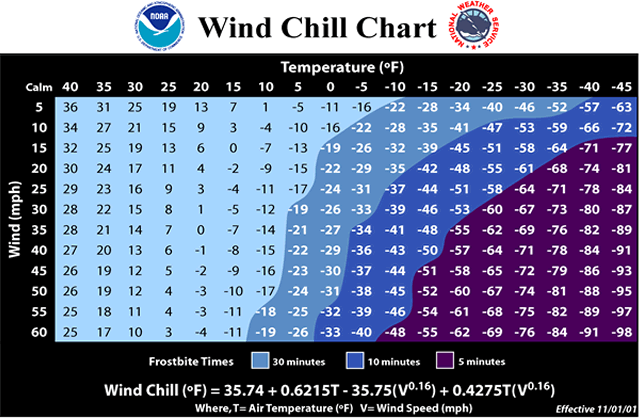
While monitoring local current and projected morning temperatures, P-H-M Administration uses the safety levels outlined in the NOAA Wind Chill Chart below in its decision making.
Parents should also monitor the weather and proactively plan following these steps:
- Dress your child(ren) in appropriate winter clothing:
- Dress in layers of loose-fitting, lightweight, warm clothing. Trapped air between the layers will insulate you. Outer garments should be tightly woven, water repellent and hooded.
- Wear a hat! Forty percent of body heat can be lost from the head.
- Wear mittens. Mittens, snug at the wrist, are better than gloves to keep your hands warm.
- Take extra precautions if your child has a respiratory condition such as asthma, covering their mouth with a scarf to help guard from extreme cold.
- Know your child(ren)’s bus pickup and drop-off times:
- Bus routing information is shared with parents at the start of the school year. You can check it by checking the infoFinderi website or contacting P-H-M Transportation at (574) 258-9565.
- Download and use the “Here Comes the Bus” app to monitor your child’s bus on your cell phone or computer in real time through GPS tracking. Click here for details on how to download and use the app.
To ensure that our students are kept warm, P-H-M also follows these steps:
- School Buses are started early and warmed for students prior to the routes beginning.
- School bus drivers allow extra time for students to make it to and from bus stops on inclement weather days.
- School Buildings are brought up to temperature hours prior to the arrival of students to ensure equipment is working properly and the buildings are warm when students arrive for the instructional day.
Parents who choose to send their child(ren) to school have the option of driving to the bus stop and keeping the child(ren) in the car out of the elements until the bus arrives at the bus stop. Parents can also choose to transport their child(ren) to school utilizing the school’s designated parent drop-off lanes and procedures.
Ultimately the responsibility of deciding whether to send their student(s) to school or keep them home rests with parents. If parents feel conditions are not safe for their child(ren) and choose to keep them at home, they should contact the school attendance line; it will be counted as an excused absence only if the school is contacted that day.